 RSGB News
2015 Mar-Apr WRC Newsletter
Page 1
be giving it your support and look out for Wythall Radio Club meets from 8pm every Tuesday and Friday evening at Wythall House, Wythall Park, Silver Street, Wythall, B47 6LZ, near Birmingham. Visitors are very welcome. Wythall Radio Club is affiliated to the Radio Society of Great Britain. Contact g0eyo@blueyonder.co.uk Wythall Rally comes home. As you read this we are in the final week before the 30th An- nual Wythall Radio Rally. For the past 11 years we have held this at Woodrush Sports Centre, but the past two years have been plagued with park- ing issues due to building works, of which even more were promised for 2015. Thus your committee decided in April 2014 to bring the rally back to Wythall Park where is spent the first 18 years of its life. The rally scene was much bigger then with events in the Midlands every month from our rally in March right through to Leicester in October. Who can forget the pleasure of visiting, Drayton, Elvas- ton Castle, Telford, Leicester, the Straw- berry Rally at Droitwich to name a few. Alas, apart from Telford, they are no more and those that are left are strug- gling with finding suitable venues, trad- ers and visiting public. However we al- ways put on a good show at Wythall so we have hired the Park Hall, Britannia Room and the Scout Hut and hope to fit nearly 30 traders into that space. In the old days at Wythall we used to have to hire a marquee which was set up be- tween the Park Hall and the Scout Hut. A whole weekend of work went into pre- paring for that rally, but of course we were all much younger then. We even had to hire security to look after the mar- quee over night because of local van- dals and we always had a bit of party in the Scout hut on the Saturday night. Parking was also an issue in the old days. We soon outgrew the Wythall Park carpark and had to bus people in from land that we hired from Britannic Insur- ance in Middle Lane. All these costs got too much and we moved to Woodrush. Anyway we are back and with all the volunteers helping we expect it to be a success and add to the funds which keep the club running. I am sure you will newsletter wythall radio club “having fun with rf” wythall contest group
www.wythallradioclub.co.uk facebook.com/wythallradioclub www.wythallradioclub.co.uk Mar –Apr 2015 those bargains. The Christmas contest again proved to be a big success with some members adopting differ- ent strategies and modes. Chairman Mike G4VPD fought off tough opposition from David G7IBO to take the crown in the Open section with Peter M5DUO coming third by a short margin over Anita 2E0DUO. In the FM only section, Jim 2E0BLP came first with son Kevin 2E0NCO coming a close second. Colin G6ZDQ came third. Special certificates were awarded to the top Foundation Licensees in each section, duly won by Sylwia M3SSP and Jamie M6GDI. Special “out- of-town” awards were also made to Dar- ren MW5HOC and his family, all of whom came on air from South Wales during the event. John M6KET picked up an award for top CW operator and Chris G7DDN was awarded a certificate for the largest number of D -STAR contacts during the contest. It won’t be long before we will be doing it all again for the Easter Contest . We have a very interesting programme of events coming up over the next two months. Chris G7DDN has got speakers coming in to enlighten us on various top- ics, viz; March 17th “Having fun with QRP CW “ with Barry M0DGQ March 24th “Quiz Night – Could you still pass your Ham Exam” with Chris G0EYO April 28th “ A beginners guide to RTTY “ with Lee G0MTN May 19th “ Visit by Don Beattie G3BJ President of IARU Region 1” Plus of course various contests, a visit to Kempton Rally and the usual social events. Something for everyone to look forward to. Chris G0EYO
Page 2
work very well. Time and time again has proved- it pays to check previ- ous repair work. With a few basic checks done and the yellow wire back in place, it was powered via the bench variac. The use of a variac to gently “wake up” equip- ment that has lain dormant for a long while is frowned on by many braver souls than me..mind you I still have all my eyebrows which perhaps proves caution is the best option. I remember being taken to task by the late Gerry Wells of the British Vintage Wireless Museum in London, who was a “show it full mains and stand back” type of engi- neer. Mind you, his party piece was from behind the safety of two thick- nesses of reinforced glass, to “explode” and old electrolytic multi section can capacitor, and shower the room with shreds of silver paper. All went well until one lifted off into orbit straight through the corrugated roof!
Electrolytic Capacitors have always de- teriorated if unused, they last so much better in equipment that is used regu- larly. They need to have the DC polaris- ing voltage across them which is present when the equipment is switched on and working, so use them or loose them as the saying goes. Modern electrolytic Page 2 Mar-Apr 2015 On the Repair Bench—The “Classic” Linear Conchord Marketed by RSC of Leeds from the early 1960’s the Linear Conchord 30 or 50 pro- vided less expensive alternatives to the big players in the guitar amplifier market.
Priced at around 15 guineas for the 30 watt version, they proved to be the main stay of many a fledgling rock band. Hav- ing said that we are talking “real” watts here, not peak, and the measurements cannot be equated to some of today’s bizarre rated equipment. As an example, I have a very small stereo amp (transistor) that boasts 80 watts peak per channel and runs off a 12v 3amp supply. (I will leave you to do the maths)
The Conchord, as a budget amplifier only had two inputs (lo and hi) and very simple mixing between those two inputs, so bands aspiring to get on the circuit needed more capability in terms of power and input choice. Ultimately these amps ran out of steam and were retired, usually to store cupboards or just forgotten about. But not this one.
Found in a dark but thankfully dry corner of an antiques flea market, this amp was complete and a quick look underneath seemed to confirm what the seller was saying- complete but had been subject to dubious repair and did not work very well. Whilst the Station Manager was in a queue for a hot chocolate beverage, I headed off and popped the Conchord into the car boot.
On the bench it seemed to be in reasonable condition, the ham- mered metal paint was showing signs of deterioration, one tag board had suffered from compo- nent burn up and various com- ponents had been replaced. It used Belling Lee TV type TV coax connectors for the inputs which even by standards current at the time was a strange out- dated choice-the standard being RCA Phono.
Without wishing to spend a lot of time on the cosmetics only to find the output transformer or mains transformer was faulty, I prepared to check the previ- ously done work with the intention to connect a speaker and show it some mains.
The repair work was pretty awful and did I spot a yellow wire connected to fresh air! I sure did, it was the anode connection from the phase splitter so that would be the reason it did not
Page 3
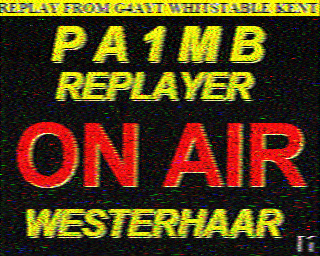
Page 3 Mar-Apr 2015 Receiving pictures from the ISS These are the pictures that I received and decoded from the International Space Station through the night yester- day and early this morning. RX was on 145.800 using a vertical col- linear in the loft. Received on an IC 7100 and MMSTV for decoding. The mode used was PD180 and the pic- tures are 640x496. Each image took a few minutes to re- ceive and it was interesting to see where the signal faded in relation to the position of the ISS e.g. if you look at middle top pic, this was the closest pass of all and the noise part 2/3 of the way down was when the ISS was almost directly over- head!
Great fun and great to hear the ISS, I did try and contact them but I think they were in QSO with a Russian station. Google ISS SSTV to see other stations recep- tions. Jon M0JMM On the Repair Bench—The “Classic” Linear Conchord ...cont’d caps are very cheap and quality is poor. I have had some fresh new ones that have “blown” the seal even before use.
Not wanting to destroy a transformer, the amp was run at 190v for a couple of hours before increasing to 240v. It soon became apparent that a crackling was persistent and I suspect the cheap metal ended resistors were the cause. Widely used in budget equipment, the metal end caps were crimped and over time, lose their grip. They also drift horribly in value.
Having now arrived with a basically working amplifier, the decision is now- how much to restore. I have not yet looked at the reproduction of a sine wave input on the oscilloscope, I sus- pect at this stage it will be pretty noisy and distorted due to component aging. Ideally I would re-build both tag boards with new components, some amplifiers used a single tag board which was sufficiently long and this replaced the two separate ones in my design.
The Linear Conchord may have been available as a kit (a lot of the RSC equipment was avail- able as a kit or fully built and tested) but I suspect that as a lot of items were riveted, my amp was ready built and tested.
So the first task is to remove the two tag boards, and make up new ones, and in the meantime assess the condition and decide if this is going to be a com- plete strip down and re- build. The valve holder is a concern despite the pin being the cathode connection.
In Part Two I will detail the refurbish- ment to final testing.
Ian Reeve M0IDR
Page 4
Page 4 Mar– Apr 2015 Test Equipment - The Semiconductor Tester Grouping transistors by type and gain is a useful way of finding suitable candi- dates for experimentation. Capacitance & Resistance can also be measured as shown here. A useful piece of test equipment, al- though you do have to homebrew a suit- able enclosure. So much keenly priced gear nowadays is available and with the prospect of one similar to the Peak but at a fraction of the cost, times have never been easier to invest to make life at the repair bench easier.
Ian M0IDR recognised BC108, AC126 types. This is where the Analyser is invaluable, three connections to the pins will give pin out, type, characteristics including gain and a host of other info. Crucially it will tell you if the device is duff or too leaky. So after purchasing a box full of used semiconductors, it was good to run through them with the analyser and to categorise them into PNP or NPN or Darlington or JFET or…and the list goes on. Duff ones are identified, quite often it might be a junction short or open in which case the transistor might serve as a diode. This Analyser does the lot, but it is seri- ous money to buy and you have to fre- quently use it to justify the initial outlay.
So what are the alternatives?
Component testers and basic transistor testers have been available as multimeter function for some time now and so I will not dwell on those. A new type of tester has become available from the Far East which can test capacitors, resistors and semiconductors and they are very keenly priced.
There are other versions which include inductors in the test capability so there is plenty of choice.
How do they perform?
Actually they do pretty well, generally you get a “bare bones” pcb and you have to put it into a suitable case yourself al- though some cased and ready to go ver- sions are available. In this example we have a bare bones tester-connections for the test leads have to be fabricated but it does test components for basic function and value. For transistors it will identify the pin out and provide type and gain which is adequate for a go/no-go test. As readers may know, I go round radio rallies scooping up bargain boxes of this and that and have quite a large collection of used ex equipment, new and surplus semiconductors. So how do you find out what they are and are the three legged friends still within spec? Peak Atlas recently introduced their top of the range Semiconductor Analyser. This analyser performs all of the usual pin out, type, leakage, gain identifica- tion on nearly every semiconductor type available. In addition, usb connectivity to a standard PC gives the analyser a whole new range of functions including semiconductor curve tracing. Small enough to be held in the hand, the three coloured leads provide the connectivity to the device under test. Operation is easy with results being displayed on the screen. As the ana- lyser identifies the pin outs, the device under test can be connected any way round to the test leads. Of course you could read the transistor type from the markings, but increasingly they are obscure type with manufactur- ers markings as opposed to the more
Page 5
Page 5 Mar-Apr 2015 Recently Darren MW5HOC tweeted Tim Peake, the UK astronaut who is going to the International Space Station (ISS) for 6 months in November. He asked him if he would use the ham radio station to talk to British hams, as we only ever hear the crew talking to Russian hams. Tim replied saying that he was looking forward to using the ham radio and will certainly be looking to talk to UK hams.
Having a British astronaut on the ISS is a great chance to promote our hobby. Darren is getting a plan together to get a station on the air at his son Philip’s school. One of his teachers is a lapsed ham, and he seems keen on the idea, of having the school contact the ISS.
At Darren’s suggestion, I contacted Gra- ham Coomber General Manager of the RSGB to see what they had planned for this unique opportunity. He said that they have this well in hand and are working closely with the UK Space Agency. He said that Ciaran Morgan, M0XTD, was leading the project for the RSGB. He thought it was very likely that demand for contacts was likely to far outstrip supply! We need to try and capi- talise on this, and get as many UK hams working the ISS as we can, although being it is likely that educational organi- sations which have first priority.
Some ISS crew members make random, unscheduled ham radio contacts during their breaks, pre-sleep time and before and after mealtime. Astronauts have had QSO’s with thousands of hams around the world. The work schedules of the ISS crew dictate when they are able to operate the radios. The crew's usual waking period is 0730 - 1930 UTC. The most common times to find a crew mem- ber making casual periods are about one hour after waking and before sleep- ing, when they have personal time. They're usually free most of the week- end, as well.
The crew can operate the 2-meter packet radio in unattended mode, and hams can make contacts with the ISS station when the crew members are working. Hams can also communicate with each other using the ISS packet (computer) radio mode, or receive slow scan television mode images. It all de- pends on what equipment is in service in space.
A typical ground station for contacting the ISS station includes a 2-meter FM transceiver and 25-100 watts of output power. A circu- larly polarized crossed-Yagi antenna capable of being pointed in both azimuth (North-South- East-West) and elevation (degrees above the horizon) is desirable. But successful con- tacts have even been made with vertical and ground plane antennas.
Frequencies in Use The following frequencies are currently used for Amateur Radio QSOs: Voice and SSTV Downlink: 145.80 (Worldwide) Voice Uplink: 145.20 for ITU Region 1 (Europe, Russia and Africa) VHF Packet Uplink and Downlink: 145.825 (Worldwide) UHF Packet Uplink and Downlink: 437.550 UHF/VHF Repeater Uplink: 437.80 UHF/VHF Repeater Downlink: 145.80
Call Signs in Use The following call signs are available for use on the ISS:
Russian: RS0ISS USA: NA1SS European: DP0ISS, OR4ISS, IR0ISS Packet Station Mailbox: RS0ISS -11 and RS0ISS-1
Other call signs may come into use as the station and crew change. Tim Peake is a for- mer British Army Air Corps officer and is the first British citizen to be selected as an astronaut by ESA. Peake began ESA's intensive astronaut basic training course in September 2009 and graduated on 22 November 2010.
For more information on the ISS see http:// www.ariss.org/contact -the-iss.html
Chris G0EYO British Astronaut to visit ISS in November Randy Wisemand KF5LKT Tim Peake
Page 6
Page 6 Mar– Apr 2015 My Lady Catherine—A poorly lady on my workbench! The Vidor name was conceived by Tho- mas Cole who split from Lissen when Ever-Ready took them over. He named the Company from a combination of Val- erie & Denise (his daughters) and his wife Rebecca – ViD oR Kinda rolls off the tongue. Thomas set up his Company in direct competition to Ever-Ready and produced batteries but quickly moved on to the manufacture of wireless sets and more specifically “Attache” style portable valve radios. It was a boom time for the wireless manufacturers and they were seeking a way to introduce a carry anywhere wireless, the fore- runner of our port- able transistor radios. With the introduction of low voltage (battery) valves, the con- cept of a truly port- able wireless be- came reality and some of the most popular were di- rected specifically at the feminine market and Vidor stole a march on it’s rivals by using names like “My Lady Margaret” “My Lady Catherine” “My Lady Anne”
Ever-Ready were using names like Sky King and Sky Mas- ter which didn’t have the je ne Sais quoit it seemed. Covering both Medium and Long wave, these sets employed 4 bat- tery valves in a totally standard superhet circuit. Valve filaments supplied by 1.5v and HT was 90v. The batteries were so designed to run down at an equal rate and so both would need replacing together and although bat- tery life was reasonable the replacements were relatively costly. Mind you the set, introduced in November 1956 was priced at £12-1-6d which would be £276 in to- day’s money.
This particular set came in two colour vari- ants, red/cream or blue/grey, and became known as the Robot Face model- hardly flattering.
It sold very well and was bought as a set to listen to when enjoying picnics in the park, on the beach or indeed in the grounds of ones stately pile. Having a substantial plywood case, heavy metal fascia and a large loudspeaker, the sound quality was excellent and plenty of sta- tions were pulled in by the antenna built into the lid. Early versions used an all metal construc-
Page 7
Page 7 Mar-Apr 2015 tion with good old fashioned point to point assembly with the occasional tag strip added for good measure, later versions used a new-fangled printed circuit with ex- actly the same circuit. The lady on my bench had had a hard time at the hands of a bodger. Her loudspeaker was in tatters and her tuning capacitor had been damaged and so the question arises, do we restore or use her for parts.
Her loudspeaker was a standard design My Lady Catherine continued way and where’s the superglue was uttered. A familiar phrase used amongst restorers of these sets, but especially so with Ever-Ready where the translucent green marble ones are as rare as hens teeth for that reason.
As it happens, I had a replacement speaker and tuning capacitor- well who doesn’t ?- and a few moments later-well over half an hour actually- the new tun- ing capacitor and speaker were in situ. The tuning capacitor was mounted via rubber bushes which had perished and I had to find replacement grommets from my man store before fitting the new one in place.
All back together now, close the front panel. Oops, it won’t close properly, the magnet on the replacement speaker is a bit larger and fouls on the output trans- former preventing a proper closure.
Re -locating the speaker and extending the leads from the audio output trans- former to the speaker sorted that and once again this Lady sings.
No further components needed replace- ment and the set has performed very well indeed.
Various other Manufacturers produced similar sets but Pye and Pam both pro- duced a range of very attractive sets, a little larger than the Vidor, but they had wonderful chrome plated panels and looked wonderful. Equally fragile control knobs though, early plastic as it ages becomes very brittle and many a good set has been skipped because the con- trol knobs broke in use. Pye went on to introduce an all transis- tor model in the same Attaché case style but times had moved on and they were left napping.
Out of all the makes, Pam are the rarest and most desirable but strangely enough they were just badge engi- neered Pye. Sounds familiar doesn’t it with today’s range of consumer brands all re-branded with slight tweaks to make them seem different from the rest.
Ian M0IDR
and the tuning capacitor a standard twin gang but the real issue with these sets is removing the control knobs with- out breaking them. The tuning one used a collar and screw to tighten it on the shaft but the volume control was a push on one and the circular springs that were used were overly strong. Put- ting them together at manufacture was one thing but trying to get it back off was another and no way would it budge or be persuaded until it suddenly gave
Page 8
Editor: Chris Pettitt G0EYO, 23 Dark Lane, Hollywood, Birmingham, B47 5BS. Phone: 07710 412 819, E-mail: g0eyo@blueyonder.co.uk Page 8 Mar-Apr 2015 The next issue of the Wythall Radio Club Newsletter will be published at the beginning of May 2015 Ofcom publish their intended licence changes Following the consultation last year, Ofcom have published their intention to change our licence conditions as follows;
provide Full Licence holders access to additional frequencies in the 470 kHz and 5 MHz bands respec- tively. Hitherto, these bands have been available to licensees only by way of an individual Licence varia- tion. We have decided to incorporate the terms and conditions of those variations into the Licence, amended in line with comments received from con- sultees, notably concerning radiation hazards;
provide a mechanism by which an Amateur Radio club’s call sign can remain with the club, by expand- ing the grounds for revocation to include cases where a licensee ceases to represent that club, so allowing us to reassign the call sign to a new licensee;
update the provisions on revocation by: introducing a further ground of revocation where the licensee has been convicted of an offence under the Wireless Telegraphy Act 2006 (“the WT Act”); and amending the provision enabling a Licence to be revoked if the licensee fails to revali- date the Licence every five years by remov- ing the reference to this process happening “automatically”.
ensure consistency with other Ofcom licences in the way that the Licence makes reference to fees;
clarify certain provisions relating to the transmission of call signs, namely requiring the station to be identifiable at all times and requiring that a call sign to be transmitted as often as is practicable, rather than at fixed intervals. We also intend to include a requirement that a call sign be transmitted in voice or other appropriate format consistent with the modulation in use;
clarify the rules around the use of the Licence in multiple locations; and • update certain provisions to better facilitate RAYNET3 operation.
update the tables of frequencies in Schedule 1, to reflect changes in the status of allocations, resulting from World Radio Conference 2012.
In the Consultation Ofcom also proposed to make changes to clarify the use of Regional Secondary Locators (“RSLs”) and suf- fixes for Foundation, Full, Full (Club) and Full (Reciprocal) Li- cences, and to clarify the use of RSLs in the call signs of Interme- diate Licences.
Following responses from consultees however, Ofcom will not be making any of the changes it was proposing in this regard.
Ofcom also intend to update their published Guidance in due course. This will address a number of areas identified by stake- holders where guidance would be helpful but where Ofcom do not believe that amendments to the Licence are needed (for example, in relation to Unattended and Remote Control Operations; and in assisting overseas officials recognise the UK Amateur Radio Li- cence as an official document).
Ofcom received almost 2,000 responses to the Consultation, al- most exclusively from individuals. Training News It has been a busy couple of months on the training front. We kicked off a class- room Foundation course on the 26th of January with 5 students; Kevin, Dave, Zaid, William and Jonathon. We also started an on-line course for 10 stu- dents, of which 7 were local to the West Midlands. And of these 7, five took the Practical Assessments with us on Sun- day 1st of March. Therefore on Monday the 2nd of March we will have10 people sitting their Foundation Examination, a record for Wythall. We wish them all best of luck for a pass.
At the same time as running the two Foundation courses, I have been tutor- ing 8 students who are doing the Ad- vanced course through the Bath Ad- vanced Distance Learning programme. This initiative is run by Steve G0FUW and is in its fourth year. Each course, of which there are two per annum, has about 90- 100 students spread around the country and about a dozen of us tutors get a handful of students to mentor and mark their homework.
We also have three club members, Anita, Howard and Terry, taking their re-sits of the Advanced Exam at the club on Satur- day 7th March (day before the rally), cour- tesy of David G0ICJ and Roger M0GWM who kindly volunteered to be invigilators. We wish them well and hope to hear them with their new M0 calls soon.
I am working on an Intermediate Class- room course to start in early April and we already have a number of club members and others interested in taking this course. Roger M0GWM, who has been my ap- prentice on the last two courses is now taking some of the classes and has also applied to be a Registered Assessor which means he can sign off on Practi- cal Assessments. None of these courses could run of course without the support of our trainers, Dave G3YXM, Barry M0DGQ and Peter G4LWF and our invigilators, David G0ICJ, Mike G4VPD, Roger M0GWM, Anita 2E0DUO and Darren M0WYH plus other club members who make sure the class room is clear, radios are charged, and the coffee supplies replenished.
Chris G0EYO