

THE FOREST GUMP OF MORSE KEYS:ANOTHER BRILLIANT PIECE OF RESEARCH AND RESTORATION BY CHRIS PETTITT G0EYO
The Forest Gump of Morse Keys
To paraphrase Forrest Gump,” buying morse keys at auction is like a box of chocolates, you never know what you are going to get”
Members will have seen from a recent G4WAC groups.io forum message that I purchased five morse keys at a public auction in Buckinghamshire. You are never quite sure what you are going to get when you bid online, purely on the basis of a photograph in the auctioneer’s catalogue, and not being able to attend a live viewing beforehand. I wasn’t disappointed with my purchase. However, I paid a bit more than I had hoped, because the lot was fiercely contested by one other bidder. There are then auctioneer’s fees and packing and delivery costs to added to the bill.
The five are shown below. They included (left- to-right)
- A brass Japanese copy of the American J38 skeletal morse key
- Another version of the Great Telegraph Company Key I wrote about earlier
- An unknown heavy duty morse key which seems to have had a life.
- A Bulgarian military morse key with cover
- A version of WT 8 amp military morse key from WW2 manufactured by N.E. Co and dated 1941
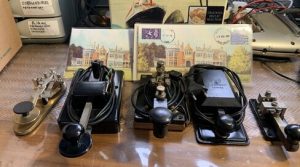
I decided to research the unknown key. It was well made of solid brass but incomplete. There was a story there to be discovered and written about.
But first let me try and explain how I found myself to be an unexpected Morse Key collector. I have been a Short Wave Listener since I was 11 years old. Some of you may know that at 16 I was taken on as a trainee intercept radio operator by what was GCHQ but better known to the public as the Government Composite Signals Organisation. I spent 12 months at Bletchley Park learning how to receive morse, take down 5 letter code and text with a pencil or a typewriter. I also learnt the fundamentals of radio and antenna theory. Strangely, as an intercept operator, I was never required to send morse by hand with a key. However the seeds were sown for the wonder of radio and communicating using CW which could always get through when other modes could not.
I didn’t stay a government radio operator for too long. At 19 years old, I wanted some technical qualifications, and shift work didn’t help, so I got a job with Plessey Communications in Ilford as a technical assistant and took myself off to night school and gained my C&G Full Telecommunications Certificate. What followed was a lifetime in the Communications and Broadcasting Industry, ending up with a senior position with the Marconi Company and retiring in 2007. Along the way I got my Class A Ham licence in 1986 and joined the Wythall Radio Club after a job move to Birmingham to run Eddystone Radio Ltd for The Marconi Company. Although I never used my morse skills for nearly 40 years, it was always on the top of my “to do list”. Eventually, in 2023, inspired by John M6KET, and with his encouragement, I decided to get to grips with the mode and learn to use it proficiently.
So why the morse key collecting?. Well, I have always been a bit of a hoarder. Old radios, books, pictures, ceramics, roman coins and the like. I also enjoyed the thrill of bidding at auctions. Once I started to use a key myself, I began to appreciate the history behind the instrument and its role in the development of communications; first with railroad telegraphy, undersea cables, then ships to shore, and finally civil and military telecommunications, including intelligence gathering. There are thousands of different types of morse keys and thousands of people collecting them each key with a specific purpose and history to be discovered. Morse code, as we know it today, i.e., encoding letters and numbers in a series of dots and dashes, was an invention of Alfred Vail, an assistant to Samuel Morse in 1844. It is a historical reality that Morse stole the idea from Vail.
CW is no longer used commercially or possibly even militarily. Marine Radio Officers were replaced by GMDSS systems and satellites at the end of the 1990s, and most countries removed the need for CW proficiency as part of the ham radio licence in the early 2000s. Strangely enough, since it is no longer a regulatory requirement, the use of CW in ham radio has grown. It has a large band of dedicated followers world-wide, and more are learning to use CW every day. I class morse keys into three types:
- Morse Keys that earned a living, (i.e. used professionally)
- Morse Keys that are used by hobbyists (including ham radio)
- Morse Keys that are more like works of art, push the boundaries of technology and are likely to be hand built.
Because of my connections with both the radio interception world and with the communications industry, I find I am attracted to the first category of morse key; those that have been used professionally. When I buy a key, I will do as much research as I can to find out how, where and when it was used.
This unknown key had clearly had a busy life. It looked like a professional key but it was stripped of all but its basics and had been mounted on a plywood base which had the call sign G2FCA handwritten on it. An old 1987 Callbook soon established that this was Mr A.E.Burnard of 20 Kipling Drive, Newport Pagnell, Buckinghamshire. Perhaps this auction lot came from his estate. The auction was held in Buckinghamshire.

Fortunately there are a number of morse key collections on the internet and a review of one of the largest BRUNDRITM6BRN soon found it was originally a British Civilian Morse Key manufactured by The Marconi International Marine Company (MIMCO). This company was a part of the Marconi Company that I worked for between 1971 and 1998 in Chelmsford Essex. The website identified it as similar to a Marconi Key 365A as used by Radio Officers on Merchant Ships world-wide since the 40’s (see pictures below – copyright M6BRN published with permission)
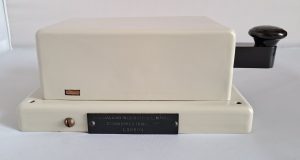
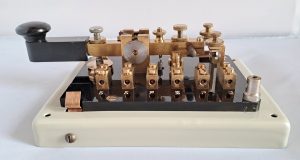
Mark Brundrit M6BRN has given an excellent description of this key and I reproduce it here with his permission
“This beautiful large Type 365A Marine Key was introduced around 1935 for use on commercial shipping lines with the installed Marconi radio equipment onboard. By the early 1940’s the replacement 365B was starting to appear. There were two versions of the 365A key, one with roller bearings and one with sleeve bearings, the latter being the version that this example falls into. They came in various coloured paintwork from shades of blue to shades of grey all on the cast brass base and pressed brass cover. The paintwork on this example was beyond saving so has been re-painted in Battleship Grey RAL 7032. Both the 365 and 365A keys came fitted with a secondary set of auxiliary contacts operated by means of a crossbar in the arm behind the fulcrum. These contacts were used to desensitise the receivers on key down. There was also an earth post mounted in the rear right-hand corner. The reason for the use of either roller or sleeved bearing is not certain but it is an opinion that either sleeve bearings were fitted to early keys and later keys with uprated roller bearings or that they were originally fitted with roller bearings and only fitted with sleeve bearings during the war when there was a shortage of roller bearings, my opinion is that of the latter as both sets were used at various times on both the 365A and 365B keys.”
A quick comparison of the key I bought and the picture of the Marconi 365A above shows that there is quite a difference e.g;
- There is no base or cover box.
- The 6 brass terminals for the auxiliary circuits are missing.
- The secondary set of auxiliary contacts and cross-bar is also missing.
- There is no earth post mounted in the rear right-hand corner of the base plate.
However, there was enough similarity to be sure that my key was a version of the Marconi 365A. On the Morsemad.com website I found a list of variants which I summarise below and thank John Snell G0RDO of Morsemad for his permission to reproduce it here;
- Key 365A – A late 1930’s Marconi M.I.M.C. Co. Type 365A Morse Key. Note the row of six connecting strips labelled TR TL BR BL AC AC. This key was available with either Sleeve or Roller bearings, designed as cheaper edition of type 365 key. Single main contact and two back contacts.
- Key 365B- A Marconi Key Type 365B Morse Code Key from the early 1940’s. A shorter arm and with just three connecting blocks, this model was fitted with two coils, two capacitors and a resistor to assist in key-click suppression. Again, available with either Sleeve or Roller bearings. A similar design to the 365A, but with single change-over contacts.
- Key 365C – There is a scarce Marconi Key 365C which is basically a 365B with money saving modifications as yet, not identified
- Key 365D – A Marconi Key Type 365D. It’s not a 365A with bits missing. It is a 365D, assembled with the basic parts, eg. no lid, no key click suppression etc. from the 1940’s. Legend has it that complete 365B keys became unobtainable during and after the war and various Marconi Marine service centres around the world put them together from spare parts they had in stock.
- Key 365EZ – This was developed from the 365A and 365B keys, it has ball-races and lots of key click suppression circuitry but the main difference is that the brass cover has now been replaced by an “Eddystone” stove enamelled diecast box Type 6908P to save costs SEE NOTE 1.

Looking closely at my purchase, you can see that, although not fitted, the plastic base plate has the holes for the terminals and the key-click coils. The brass key arm has the hole at the end for the auxiliary contact crossbar. The connecting lead is also wired directly to the fulcrum assembly and “stapled” to the plywood base to remove stress tension on the wiring connection. This is the work of an amateur radio enthusiast who turned what he had into a useable solid straight key. The original plastic base has been hacked about to make it slightly narrower and shorter.
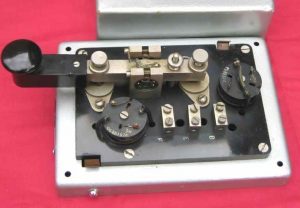
Having identified the key, I was now faced with a decision of what to do next. In its present purchased state it was probably not worth much (unless someone needed one for parting out), certainly not what I paid for it. An original 365B complete and in good condition could be worth £300. I didn’t think it is worth trying to restore this one back to its original form, again, where would I find the parts?. I decided to strip it down and clean it up, mount some electrical terminals and replace the plywood base with something neater (perhaps a 3D printed base box?) and use it as a nice clunker straight key when the fancy takes me. Fortunately, a member of Wythall Radio Club, Neil G1TZC had recently purchased a 3 D printer and had had some success making 3D parts for other club members, on the basis of a donation being made towards club funds. Neil quickly agreed to take on the task of designing and making a box into which my key can sit, if I could give him an outline specification of what I was looking for.
The depth of the box had to be sufficient to allow for a comfortable height to hold the key knob when sending. I thought 35mm height would be OK. It also would allow me to fix mini weights into the base to give it better stability, and I decided that Motorcycle wheel weights would be perfect and purchased the following from Amazon (see below). These had self-adhesive backing so would be easy to fix in the base. Each strip is about 135 x 20mm and six strips would give me about 12.6 oz (350g) dead weight, which should stop it drifting around the table when in use.
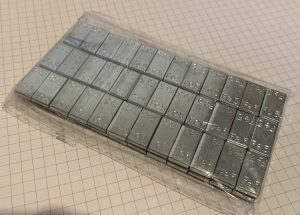
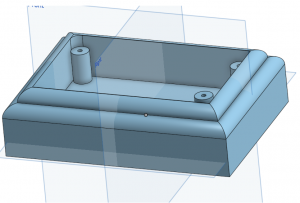
Neil set about designing the box and we had some discussion over the phone on some of the finer points. In discussion it was decided we needed to leave enough space to add more weights if necessary. He finally came up with the sketch shown below after we changed the height of the box to 45mm giving a comfortable top of key height of 61mm. He also introduced an Art Deco look about the box, with twin curved stepped perimeter on the top of the box.
Neil returned the base box and key to me for me to play around with the weights and make a final decision as to how many were essential for a stable platform. In the end I decided that 3 layers of weights, weighing 350g was sufficient.(see pic below). I had to make some alterations to the distribution of the weights to get them all to fit in.
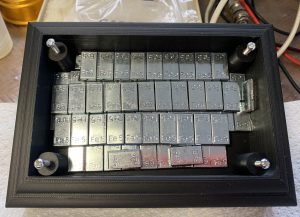
In its finished state it looks rather splendid and is a pleasure to use on air. I think this one is a “keeper”.
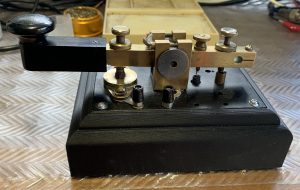
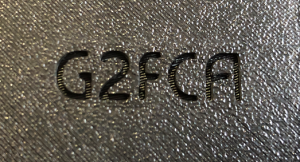
All thanks to Neil of course for his investment in a 3D printer and the enthusiasm and imagination to make it all happen. In a nice gesture and as a homage to a previous owner, Mr Burnard G2FCA of Newport Pagnell, Neil engraved his call sign on the bottom of the box. Neil’s and his wife Debra did some further research on G2FCA and from a Short Wave Magazine dated August 1952, he was mentioned trying to buy some Crystals for the Amateur Bands. In those days SWM had a monthly Xtal Xchange column to help hams get on the air with their home-brew and ex- military gear. Another reference in the SWM for May 1969 made a reference to G2FCA’s contacts on 23cm, which shows he was a serious constructor and experimentalist.
This has been an interesting and satisfying project, I’ve added to my collection and increased my knowledge. And had my first experience of 3D printing. They say every day is a school day.
Written by Chris Pettitt G0EYO
20/11/25
Note 1. The Marconi 365EZ and Marconi’s purchase of Eddystone Radio. By Ron Stringer. (ex MIMCO Sales & Marketing)
“Marconi’s had been customers for many years, but Eddystone Radio was wholly taken over by the Marconi Company (which itself was owned by the English Electric Company) in 1965. A couple of years later English Electric was taken over by Arnold Weinstock’s GEC-AEI conglomerate and both Eddystone and Marconi were part of the sale.
The company name was changed by dropping the word ‘Communication’ at around this time, to reflect the fact that the products offered to the Marine market (which included depth sounders, direction finders, radars, CCTV equipments, SRE products) were not adequately described by the original title. The reason for the Eddystone name appearing inside the cover of the MIMCo 365EZ key (and probably inside the cover of its replacement, the Z50- etc) was that the brass cover of the earlier 365 series of keys was hand made and outrageously expensive to manufacture. It only served to keep muck and foreign bodies out of the key, and to keep rfi inside the box, so it had to be replaced as a cost-cutting action.
Eddystone Radio had a sideline in making diecast aluminium boxes in standard sizes for use by amateurs and makers of machinery controls. (This was an offshoot of the way that Eddystone built the sensitive parts of their radio receivers as an assembly of screened diecast boxes, rather than by the more common method of bending and soldering compartments into a chassis made of tinplate.
Having invested in the dies, they maximised the return by selling the boxes to distributors of electronic components such as STC Components, Radio Spares and Maplin). So at Marconi we designed out the very expensive brass cover and replaced it with a standard, diecast, Eddystone box.
The Z50- was designed some time in the 1980s when Marconi Marine (MIMCo) moved its drawing office nomenclature from the general one used by its parent, MWT, to one that was specific to MIMCo. All our drawings began with Z and the sequence Z50- was used not for major products but for ancillaries such as morse keys, battery chargers, antenna switching units and so on”.
Ron Stringer.
Reproduced from Morsemad.com website.